EPM FastTrack is an SAP-certified ABAP add-on that selects, transforms and validates your financial data inside SAP before loading it to Oracle EPM — enabling every Oracle EPM figure to be drilled-down back to the SAP transactions behind it.
14
Ledgers, journals, CO-PA and more.
100%
No middleware. No external platform.
0
Everything is configuration, not development.
Independently validated against SAP standards.
SAP data extracted and manually mapped in spreadsheets before loading — error-prone and time-consuming every single period.
Data only exists in Oracle EPM format at close — no upfront visibility or interim reporting until then.
Once data leaves SAP it loses its link to the originating transaction — reconciliation becomes a manual detective exercise.
Late journals and rejections leave no time to rerun the ETL cycle — fixes happen directly in Oracle EPM, breaking .integrity between systems
SAP → OracLe EPM
No extraction layer. Most ETL tools extract data from SAP, transform it elsewhere, then load it into Oracle EPM, introducing latency into the process. EPM FastTrack does this all in SAP on the current data — so no third-party middleware, no external hardware, no file transfers.
SAP → OracLe EPM
Close becomes a confirmation. By the time the period closes, the data is already correct and ready to submit. When workflow flags something mid-month, drill-down finds the cause in minutes — so it’s fixed long before close, not scrambled for at the last moment.
SAP → OracLe EPM
Millions of records, one process. Built for the volumes and increasing reporting demands from EPM systems — ledger data , universal journal postings, intercompany transactions, cost allocations and look-ups from logistics and master data — all processed as a single run, not as a series of batch runs.
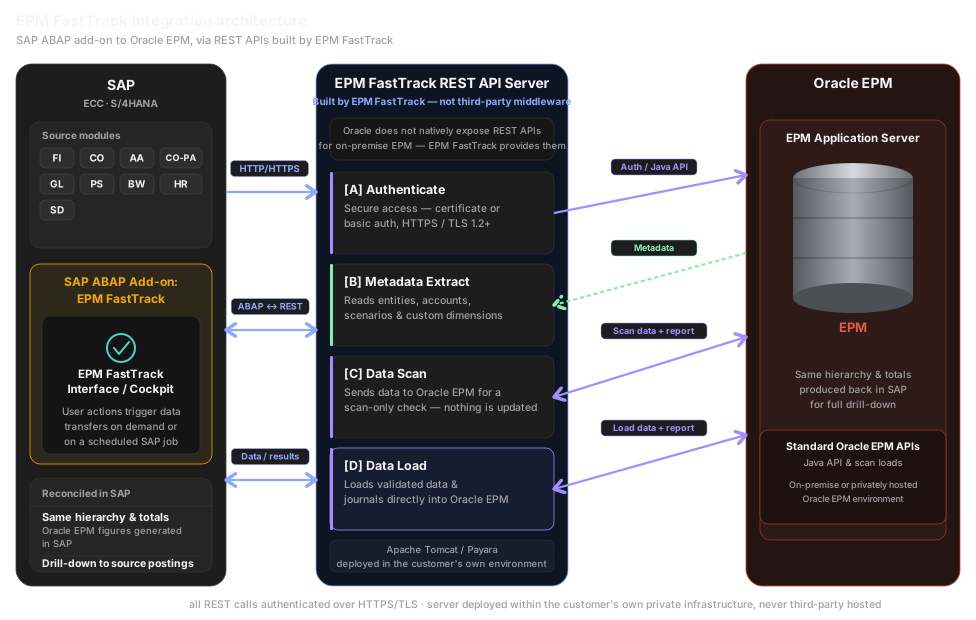
Before any data moves, EPM FastTrack retrieves the complete Oracle EPM application metadata — entities, accounts, scenarios, custom dimensions — and stores it inside SAP (and keeps it up to date). This is what makes every other capability possible: when mapping tables are configured, drop-down lists offer valid Oracle EPM member values, and any value typed in directly is checked against that same metadata and rejected if invalid. Drill-down, mapping traces and no-code configuration all are made available by SAP having a current picture of the Oracle EPM application.
SAP → OracLe EPM
Data and journals loaded directly into Oracle EPM from SAP using the standard Oracle EPM APIs — the same interfaces Oracle EPM itself relies on. Oracle EPM metadata synchronises automatically via API, so mappings and validations are always current.
Scan loads from SAP. As part of continuous accounting, these can be triggered directly from SAP — checking dimension member and intersection integrity directly in Oracle EPM and reporting results back, without leaving the SAP environment.
SAP → OracLe EPM
Reporting characteristics derived in SAP. Where an Oracle EPM dimension depends on non-financial data — such as deriving a country for geographical analysis from the customer master — EPM FastTrack can be configured to reference the relevant master data or logistics tables within SAP to determine it — no need to extract further data or develop custom code.
OracLe EPM → SAP
EPM FastTrack produces the Oracle EPM data in SAP and this is exactly what is loaded into Oracle EPM itself — same dimension values, same totals, built up through the same hierarchy. Because both the data and the hierarchy exist in SAP, any Oracle EPM figure can be drilled down directly, at any level.
Oracle EPM and SAP side by side. Drilling into the SAP-side total shows every contributing posting with both Oracle EPM dimensions and SAP characteristics — cost centre, profit centre, G/L account — in one view.
The questions that matter most for SAP customers evaluating how to connect to Oracle EPM.
|
EPM FastTrack |
Oracle FDMEE / DATA MANAGEMENT / DATA EXCHANGE
Traditional ETL approach. |
|
|---|---|---|
|
Where transformation happens. |
Inside SAP — no extraction, the moment data exists, it can be rapidly transformed and loaded to Oracle EPM. |
Outside SAP — data extracted to an external layer first; multiple connectors needed per source. |
|
When data is ready. |
Throughout the period — correct, validated data available from day one, not just at close. |
At load time only — validation runs when data is loaded into Oracle EPM at month-end, no early warning. |
|
Validation. |
Continuous, in SAP — transformed data validated against Oracle EPM metadata as it’s processed, errors flagged as they occur. |
At load time only — validation runs when data is loaded into FDMEE at month-end, no early warning. |
|
Drill-down. |
Same totals, same hierarchies — Oracle EPM figures are produced in SAP, with direct drill-down to source postings. |
Limited, coded per source — must be built separately for each data source. |
|
Set-up & adaptability. |
Code-free, two weeks — one connector for all SAP sources, scope changes made without coding, and production data can be worked with early in implementation. |
High coding effort — multiple connectors per source, changes require substantial additional coding. |
Confirm technical fit before your first conversation with us.
SAP ECC 6.0 EHP6+
S/4 HANA 1909 – 2025
On-premise & private cloud.
HFM 11.1.2.4+
Hyperion Planning
EPM FastTrack is installed, operated and supported entirely within your existing SAP landscape and SAP team.
No extra hardware, no new servers, no cloud infrastructure to procure or maintain.
Operated using familiar SAP tools. No specialist middleware team or separate support contract.
No third-party integration platform to procure, licence, or renew annually.
Independently validated against SAP standards — reduces risk for IT and security sign-off.
We’ll walk through how EPM FastTrack would handle your specific SAP setup and Oracle EPM environment.
We use cookies to personalise content, provide social media features, and analyse our traffic. We also share information about your use of our site with our analytics partners. You can change your preferences at any time. For more information, please see our Privacy Policy.